Start with the order a taco is built
Every guest builds a taco in roughly the same sequence: something to hold it on, the tortilla, the main filling, then the fresh and saucy layers, and finally the squeeze of lime. When your dishes follow that sequence along a single direction of travel, the line moves at a steady pace. When they do not — say the salsas sit before the fillings — people stop, reach back, and the queue folds in on itself.
A dependable order for most home bars runs like this: plates, tortillas, hot fillings, beans or rice, chopped vegetables and pickles, salsas and crema, crumbled cheese and herbs, lime wedges, and then napkins and cutlery at the very end. Cutlery last sounds odd until you watch guests juggle a fork while spooning salsa; with nothing in the second hand, they serve faster and spill less.
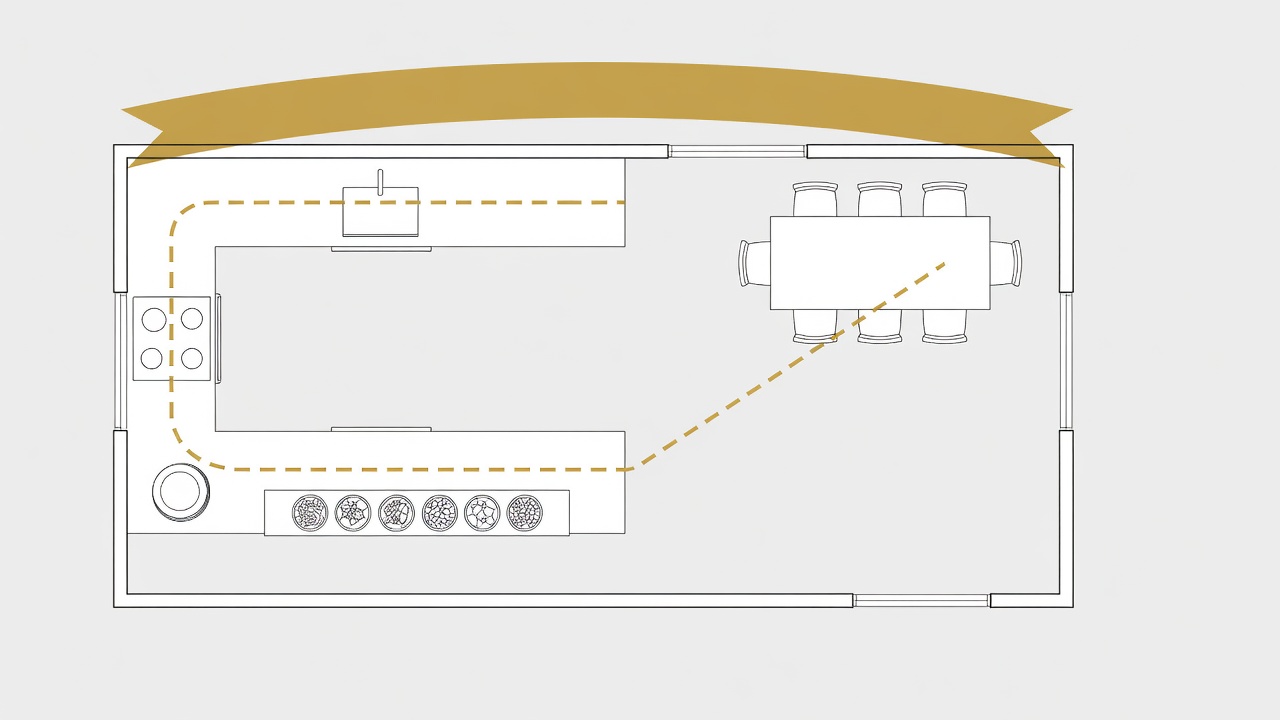
Decide which way people will walk before you put anything down. In many homes it is simply the direction from the door into the kitchen and on towards the table. Place the plate stack where people first arrive and let the rest unfold from there.
Choose a shape your room already offers
You do not need a dedicated buffet. Look at the continuous surfaces you have and pick the shape that keeps the line away from doors and from the cooking area.
The straight run
A single stretch of worktop. Simple to read, best for small groups, and easy to refill from behind if the run is free-standing.
The corner turn
Uses an L-shaped counter. Put the slow-moving salsa section after the corner so the pause happens away from the entrance.
The island loop
Mirror the line on both long sides and two guests serve at once. Our island guide covers this in detail.
The table and cart
No spare counter? A cleared dining table or a rolling cart against a wall becomes the bar, and the table becomes seating afterwards.
Keep the queue out of the cook's path
Designers have thought about kitchen movement for a long time. The "work triangle" linking sink, hob and fridge was popularised by research at the University of Illinois School of Architecture in the 1940s, and the idea still appears in planning guidance from organisations such as the National Kitchen & Bath Association. You do not need to measure anything to borrow its lesson: the person cooking moves between those three points, and a queue that cuts across them will cause collisions.
So run the line along the edge of the working area rather than through it. If the fridge sits at the far end of your only free counter, move the drinks somewhere else entirely so guests never need to open it. A jug of agua fresca or a tub of ice in the next room relieves the kitchen more than any rearrangement of dishes.
Plan for the places people pause
Watch any taco line and you will see two hesitation points: the tortilla basket, where people count how many to take, and the salsa section, where they read and decide. Give both of those spots a little extra elbow room. Space the salsa bowls out, leave a gap for setting a plate down, and keep anything decorative away from that stretch.
The end of the route matters too. Guests leaving the bar should face the seating, not a wall or a dead end. If they have to turn around and walk back through the queue to sit down, swap the direction of the whole line.
Test it with an empty plate
Half an hour before people arrive, pick up an empty plate and walk the route yourself. Reach for each dish. Notice where you twist, stretch or step backwards. Then ask someone else in the house to try it while you stand at the hob. Five minutes of rehearsal reveals the bottleneck far more reliably than any sketch, and fixing it is usually a matter of sliding one bowl along.
Once the route works, move on to the details that make each stop easy: condiment organisation for the slowest stretch, and compact seating ideas for where everyone lands.